
0
£0.00
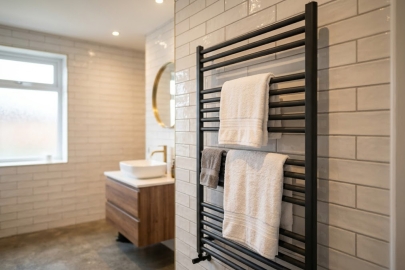
Towel rail sizing affects whether your bathroom stays comfortably warm, whether towels actually dry properly, and whether you've wasted money on inadequate heating or excessive capacity you'll never use.
Getting size right requires balancing heat output requirements with physical dimensions and towel capacity needs. Here's how to select towel rails that work rather than just fit the available wall space.
Start with your bathroom's BTU requirements rather than browsing catalogues based on what looks attractive. Even heated towel rails need producing adequate heat for comfortable bathroom temperatures.
Measure your bathroom's length, width, and height in metres, then multiply these dimensions giving you cubic volume. Multiply this volume by 150-180 depending on insulation quality (150 for well-insulated modern bathrooms, 180 for older poorly-insulated spaces).
A 2m x 2m bathroom with 2.4m ceilings has volume of 9.6 cubic metres. Multiplied by 150 gives 1,440 BTUs minimum requirement. That's your baseline before considering windows, external walls, or other heat loss factors.
Add roughly 100-200 BTU for each window depending on size and glazing quality. External walls increase requirements by 10-15%. North-facing bathrooms need an additional 10% compared to south-facing spaces receiving solar gain.
This calculation reveals whether towel rails can realistically heat your bathroom or if you need supplementary heating regardless of towel rail size.
Towel rail BTU output increases with physical size, but the relationship isn't perfectly linear because design variations affect thermal efficiency dramatically.
A 1200mm x 500mm chrome ladder rail might produce 1500-1800 BTUs, whilst a 1400mm x 600mm version produces 2200-2600 BTUs. The additional height and width combine creating proportionally greater heat output.
However, different designs at identical dimensions produce varying outputs. Flat panel towel radiators often produce 20-30% more heat than ladder designs because they've got more solid surface area transferring heat.
Always check manufacturer specifications for actual BTU ratings rather than assuming dimensions indicate output. Two visually similar 1200mm rails from different manufacturers might vary by 500+ BTUs.
If your calculation shows you need 2000 BTUs but you're considering a rail producing only 1400 BTUs, you'll be cold regardless of how nice it looks. Match output to requirements first, then choose aesthetics within appropriate size ranges.
Towel rails need adequate wall height and width whilst maintaining clearances for air circulation and practical towel hanging.
Minimum floor clearance is typically 100-150mm allowing air to circulate underneath whilst preventing towels dragging on floors. Some councils' building regulations specify minimum clearances for safety.
Ceiling clearance should be at least 150mm allowing rising heat to disperse rather than being trapped against ceilings creating hot spots whilst leaving lower bathroom areas cold.
Measure your available wall space accounting for doors, windows, light switches, and other fixtures that constrain positioning. A wall showing 1800mm height might only offer 1500mm usable height after accounting for skirting, ceiling cornice, and required clearances.
Width considerations include ensuring towels can hang without touching adjacent walls or fixtures. A 500mm wide rail needs positioning with adequate space either side for towels to drape naturally without bunching against obstacles.
Family bathrooms need capacity for multiple towels simultaneously - bath sheets, hand towels, and face cloths all requiring warming space.
Ladder-style rails with multiple horizontal bars accommodate several towels at different heights. A six-bar rail can handle 4-6 towels depending on sizes, whilst three-bar versions suit couples or individuals.
Flat panel towel radiators offer less towel capacity because you're draping towels over the front surface rather than hanging them between bars. They work for modest towel quantities but struggle with family loads.
Consider your household size and towel usage patterns. Four people showering daily need substantially more towel warming capacity than a single person or couple. Some bathrooms solve capacity challenges with two smaller towel rails rather than one large unit, distributing heat more evenly whilst providing adequate towel space.
Ensuites used by one or two people need less heating capacity and towel space than family bathrooms serving four people with children requiring frequent towel changes.
Guest bathrooms with occasional use can manage with smaller rails because they're not maintaining constant warmth or handling daily towel loads.
Calculate based on realistic usage rather than maximum theoretical capacity. An ensuite doesn't need family bathroom heating regardless of physical size if it's only serving two adults.
Towel rails range from £80 for basic 800mm chrome ladder rails to £500+ for premium designer pieces in specialist finishes. Establish realistic budgets before browsing, preventing any disappointment.
Larger rails cost proportionally more - a 1600mm rail might cost double a 1000mm equivalent from the same range. Factor size requirements into budget planning.
Installation costs vary based on existing plumbing proximity. Rails positioned near current pipe runs install cheaply, whilst relocating to distant walls adds £100-200 in additional plumbing work.
For more information about operating costs across different sizes and types, our guide on heated towel rail running costs provides detailed analysis. And when you're ready to browse options in appropriate sizes, view heated towel rail styles here at Heat and Plumb.
Towel rail sizing confuses many customers because physical dimensions don't reliably indicate heating capacity, and manufacturers don't always make BTU specifications obvious in marketing materials. After two decades in bathroom heating, we've developed straightforward processes for matching rails to actual requirements.
Our catalogue includes detailed specifications showing both physical dimensions and thermal output, which many retailers hide or omit entirely. We've deliberately made this information accessible because informed customers make better purchasing decisions.
The consultation we offer involves actual calculations based on your bathroom dimensions and requirements rather than just selling you whatever fits your budget. Sometimes that means recommending two smaller rails instead of one large unit, or suggesting supplementary heating alongside towel rails. That guidance happens before purchase, preventing expensive mistakes discovered only after installation.

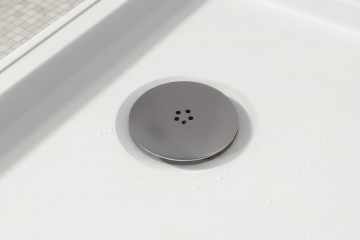
Learn about shower tray waste types, sizes, traps and flow rates, with practical advice on choosing a compatible replacement.
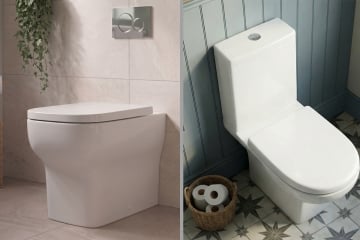
Learn how cable and pneumatic toilet flush buttons work, how to identify your mechanism and what to check before buying a replacement.
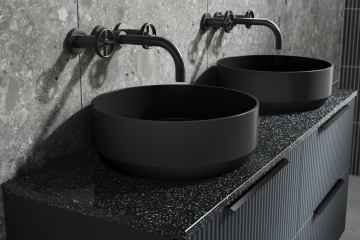
Selecting a basin for a vanity unit requires careful consideration of physical compatibility and plumbing clearances, not just aesthetic appeal. Ensuring the dimensions, mounting style, tap placement, and waste configuration align will prevent installation issues.

By signing up I agree to receive HeatandPlumb.com emails and to the privacy policy. I can also unsubscribe at any time