
0
£0.00
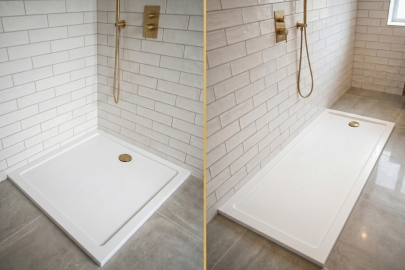
Choosing between square and rectangular shower trays affects your bathroom layout, how much floor space you're committing, and whether the shower feels cramped or comfortable during daily use.
Neither shape is universally better - they suit different bathroom configurations and personal preferences. Understanding the practical differences helps you choose based on actual space constraints rather than just aesthetic preference.
Square shower trays have equal dimensions on all sides - 700mm x 700mm, 800mm x 800mm, 900mm x 900mm being the most common UK sizes. This creates a compact footprint that tucks into corners efficiently without protruding far into the bathroom.
The equal sides mean you're committing the same amount of width and depth to your shower, which works brilliantly in some layouts whilst being wasteful in others. You get identical space in both directions regardless of which dimension you have more room to spare.
Rectangular trays have one dimension longer than the other - typically 1000mm x 800mm, 1200mm x 800mm, or 1400mm x 900mm. This elongated shape fits against longer walls whilst keeping the projection into the room relatively shallow.
You're trading width for depth (or vice versa depending on orientation), allowing shower installation along walls where square trays would either be too small or protrude too far into the bathroom.
| Feature | Square Trays | Rectangular Trays |
|---|---|---|
| Common Sizes | 700x700mm to 1000x1000mm | 1000x800mm to 1700x900mm |
| Best For | Corner installations, small bathrooms | Wall installations, narrow spaces |
| Internal Space | Compact, equal in all directions | More length, feels less enclosed |
| Enclosure Options | Quadrant, corner entry | Sliding doors, pivot doors |
| Floor Space Used | Balanced footprint | Extended along one wall |
| Installation | Usually corner-positioned | Typically wall-mounted |
| Elbow Room | Limited in larger sizes | Better length, tighter width |
| Price Range | £80-300 (standard materials) | £100-400 (standard materials) |
Square trays maximise corner efficiency in compact bathrooms where you're tucking the shower into the tightest possible space. The equal sides mean you're not wasting any dimension - both measurements serve a purpose.
In a genuinely small bathroom (say 1800mm x 2000mm), an 800mm square tray in one corner uses space efficiently without dominating the room. You've still got adequate floor area for toilet, basin, and movement.
However, square trays feel more enclosed because you're standing in what's essentially a box. Larger people or those who dislike confined spaces find square showers claustrophobic compared to rectangular alternatives that provide more length to move around.
Rectangular trays work better when you've got one long wall available but limited projection depth. A 1200mm x 800mm tray against a wall provides generous length whilst only projecting 800mm into the room - less intrusive than a 1000mm square tray would be.
The extra length creates less boxed-in feeling during use. You can shift position more freely along the length, which matters when washing hair or reaching for products without constantly bumping elbows against enclosure walls.
Corner installations naturally favour square trays because they fill corner spaces efficiently without wasting wall length on either side. Quadrant enclosures (curved fronts) work exclusively with square trays, creating space-efficient corner showers.
If your bathroom has an obvious corner that's currently unused and you want to maximise the remaining floor area, square trays make perfect sense. They claim the corner without projecting unnecessarily into the room.
Rectangular trays suit bathrooms with one clear long wall where you want the shower positioned linearly rather than in a corner. This works particularly well in narrow bathrooms where width is limited but length is adequate.
Ensuite bathrooms that are basically extended corridors benefit enormously from rectangular trays - you can install a 1400mm x 800mm tray along the length without the shower consuming the entire width of the space.
Rectangular trays generally feel less cramped because the extended length provides movement freedom that square trays can't match in equivalent floor space.
Standing in a 1200mm x 800mm rectangular shower feels noticeably more spacious than an 800mm x 800mm square despite the rectangular tray only being marginally larger in total area. The psychological difference of having length to move in exceeds what the raw dimensions suggest.
However, very large square trays (1000mm x 1000mm) provide ample space that doesn't feel particularly confined. At that size, you've got genuine room to move regardless of shape.
The feeling of space also depends heavily on enclosure type. A rectangular tray with sliding doors that limit opening width can feel more restrictive than a square tray with wide-opening quadrant doors despite having more internal space.
Square trays work with quadrant enclosures (curved corner units), corner entry enclosures with two fixed panels and hinged door, or offset quadrant designs for slightly irregular corners.
These enclosure types are specifically designed for corner installations where square trays excel. The curved quadrant particularly maximises space efficiency by eliminating sharp corners inside the shower.
Rectangular trays typically pair with sliding doors, pivot doors, or hinged doors along the long front edge. You don't get quadrant options because the shape doesn't suit corner installations the same way squares do.
The door configuration affects daily use - sliding doors on rectangular trays provide decent but not full-width access, whilst pivot or hinged doors potentially swing into bathroom space requiring clearance.
Square trays almost always install in corners because that's where their proportions make most sense. Installing a square tray against a flat wall wastes the potential for efficient corner placement.
The corner installation usually means plumbing runs to one corner of the bathroom, which might or might not align conveniently with your existing plumbing. Moving waste pipes to corners sometimes adds installation costs.
Rectangular trays install against walls in various positions depending on your bathroom layout. This flexibility in positioning means you can potentially place the shower where plumbing already exists rather than forcing corner installation.
However, rectangular trays against walls create more visual mass than tucked-away corner squares. The shower becomes a more dominant bathroom feature rather than disappearing into corners.
Pricing is similar for comparable quality and materials - a decent stone resin 800mm square tray costs roughly the same as an 1100mm x 800mm rectangular tray of equivalent quality.
You're paying for material volume and manufacturing rather than shape specifically. Larger trays cost more regardless of whether they're square or rectangular, but similar-sized options in both shapes sit in comparable price brackets.
Enclosure costs differ more noticeably - quadrant enclosures for square trays often cost slightly more than simple sliding doors for rectangular trays because of the curved glass and more complex framework.
Factor in total shower project costs including tray, enclosure, and installation rather than just tray price alone. Sometimes rectangular combinations cost less overall despite trays being equivalent.
Square corner showers can be awkward to clean in the back corner areas where panels meet at 90-degree angles. Reaching into corners with cloths or squeegees requires contorting slightly.
Quadrant enclosures eliminate corner cleaning challenges through curved glass but create their own issues with cleaning curved surfaces and tracks thoroughly.
Rectangular showers against walls provide better access to all areas because you're not reaching deep into corners. The linear configuration means you can clean methodically from one end to the other without awkward angles.
However, longer rectangular trays mean more surface area to clean overall. A 1400mm tray takes longer to scrub than an 800mm square despite the square having difficult corner access.
Taller people generally prefer rectangular trays because the additional length accommodates their height without feeling confined. Standing comfortably without constantly brushing against walls matters during daily showering.
A 6'2" person in an 800mm square shower feels cramped whilst the same person in a 1200mm x 800mm rectangular shower has adequate length to stand comfortably.
Larger builds benefit from rectangular configurations that provide room to move without elbows constantly hitting walls. The width might be similar to square alternatives, but having length to shift position helps considerably.
Compact individuals manage perfectly well in square showers and might actually prefer the cozy feeling versus feeling small in oversized rectangular spaces. This is genuinely personal preference rather than universal rule.
For guidance on selecting appropriate sizes and configurations, check our shower trays buyer's guide covering measurements and planning. When you're ready to browse actual options in both shapes, explore our range of shower trays for modern bathrooms.
At Heat and Plumb, we stock square and rectangular trays in equivalent quality levels because bathroom layouts genuinely need different shapes. After 20+ years, we've learned that the "right" shape depends entirely on your specific bathroom dimensions and how you use the space.
Free delivery across most of the UK applies whether you're ordering an 800mm square or 1400mm rectangular tray. We've got no financial incentive to push one shape over another since pricing is comparable.
What makes us different is discussing your actual bathroom layout and usage patterns before recommending shapes. Sometimes the answer is "your bathroom corner is perfect for a square tray" whilst other times it's "rectangular makes far more sense against that long wall" - we guide based on your situation, not our preferences.

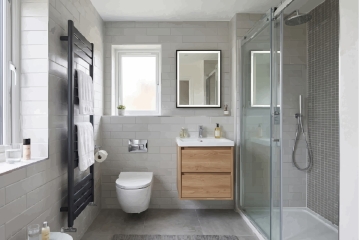
A small bathroom does not automatically require expensive fittings or extensive building work. Good planning makes a surprisingly compact room highly workable. Look honestly at what the space can actually take before choosing fittings, and you avoid costly mistakes later.
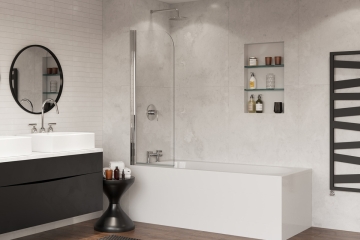
Bath screens collect water marks, soap residue and limescale quickly because they sit directly in the splash zone above the bath. Cleaning the glass, seals and moving parts regularly helps reduce staining, keeps the screen easier to maintain and lowers the chance of water escaping around worn or dirty seals.
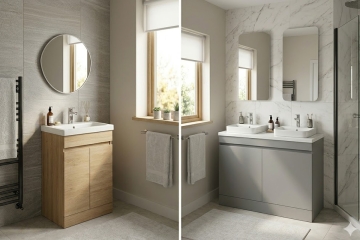
Double sink vanities devour space, cost considerably more, and often create problems they're supposed to solve. Single sinks aren't just budget compromises; in many bathrooms they're genuinely the smarter choice. Here's why the obvious answer isn't always right.

By signing up I agree to receive HeatandPlumb.com emails and to the privacy policy. I can also unsubscribe at any time