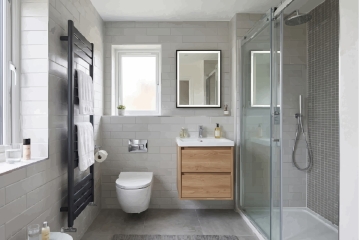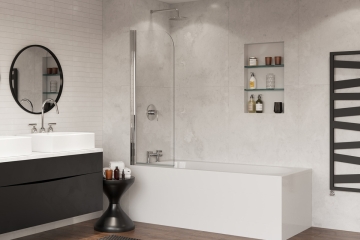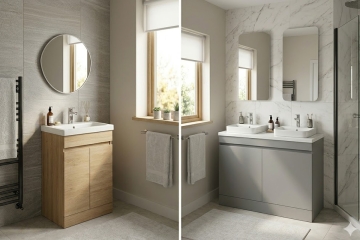
When it comes to our best shower tips for smaller bathrooms, we always insist on one thing: you need to think about the shower enclosure.
Small bathrooms demand strategic enclosure choices that maximise usable space whilst providing adequate showering area without overwhelming the room. Getting this wrong leaves you with either cramped unusable showers or enclosures that dominate the bathroom making everything else awkward.
Here are configurations that actually work in limited spaces.
1. Quadrant Corner Enclosures
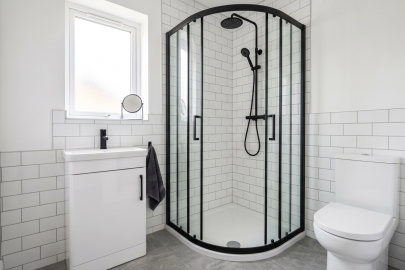
Quadrant enclosures represent the gold standard for small bathroom efficiency. The curved front design tucks maximum shower space into corners whilst minimising projection into the room.
-
The Space Advantage: An 800mm quadrant provides genuinely usable shower space - adequate for average adults showering comfortably - whilst only projecting roughly 565mm from each corner wall. Compare this to an 800mm square enclosure projecting the full 800mm and you've reclaimed significant floor area.
-
The Feel: The curved profile creates psychological spaciousness inside that defies the actual dimensions. Standing in a quadrant feels less confined than equivalent square footage in angular enclosures.
-
The Catch: Quadrants need proper 90-degree corners to install correctly. Irregular walls or non-square corners complicate installation enough that the space savings might not justify the hassle.
-
Cost & Operation: They cost more than basic square enclosures - expect to pay £200-400 for decent quality quadrants versus £150-250 for squares. Sliding quadrant doors work best in tiny bathrooms because they don't require internal or external swing clearance.
2. Offset Quadrant Enclosures
Offset quadrants are asymmetric versions where one side extends longer than the other - perhaps 1200mm x 800mm instead of 900mm x 900mm symmetrical quadrants.
-
The Space Advantage: These suit bathrooms with irregular corners or where you've got more length available along one wall versus the other. The longer side creates enough length for comfortable movement whilst the shorter side keeps projection minimal on the constrained wall.
-
The Catch: Installation is trickier than symmetrical quadrants because you're working with different radii on each side. Professional fitting is essentially mandatory unless you're extremely experienced with bathroom installations.
-
Cost: Costs run 10-20% higher than standard quadrants due to the specialised manufacturing for asymmetric configurations. You're paying for customisation that solves specific layout challenges.
3. Bi-Fold Door Enclosures
Bi-fold doors fold inward on themselves when opening, requiring minimal space either inside or outside the enclosure. This makes them brilliant for situations where swing clearance for conventional doors doesn't exist.
-
The Space Advantage: The doors typically fold into two or three sections that stack against each other when open, creating relatively wide access from narrow door widths. An 800mm bi-fold might provide 500-550mm clear opening when fully opened.
-
The Catch: The folded doors occupy space inside the shower when open, which matters in already-cramped small enclosures. You're trading external space savings for internal space compromise during entry and exit. Also, budget bi-fold doors feel flimsy and bind during operation. Invest in quality mechanisms or you'll regret the choice every time you shower.
-
Cost: Prices range from £200 for basic bi-folds to £500+ for quality mechanisms with smooth operation and durable construction.
4. Corner Entry Square Enclosures
Corner entry configurations use two fixed glass panels forming the corner with hinged doors in the front creating wide access.
-
The Space Advantage: This provides excellent entry width - often 600mm+ on 900mm x 900mm enclosures - making them suitable for accessibility needs or simply easier daily use compared to narrow sliding doors. The wide opening also makes cleaning much easier.
-
The Catch: The doors typically pivot outward, requiring clearance in front of the enclosure. In very cramped bathrooms, this external swing might interfere with toilets, basins, or general movement space. Calculate door swing arcs carefully before committing.
-
Cost: Corner entry enclosures cost £180-350 typically depending on glass quality and frame type. They're competitively priced with other corner configurations whilst offering superior access.
5. Sliding Door Enclosures
Standard sliding doors on rectangular or square enclosures provide space efficiency through their no-swing operation. Doors glide along tracks staying within the enclosure footprint without requiring clearance for hinges or swings.
-
The Space Advantage: For narrow small bathrooms where length isn't as constrained as width, a 1200mm x 800mm rectangle with sliding doors along the 1200mm front works well. You get decent internal space and reasonable entry width without consuming excessive room width.
-
The Catch: You only get roughly half the total width as a usable opening because one panel must remain in place whilst the other slides. A 1000mm enclosure provides maybe 450-500mm entry width. Track maintenance also matters highly here to prevent sticky operation.
-
Cost: Sliding enclosures range from £150 for budget options to £400+ for quality frameless designs.
6. Walk-In Shower Screens
Walk-in screens aren't full enclosures - they're single or paired glass panels creating partial barriers without doors or complete enclosure.
-
The Space Advantage: When they work, walk-ins create a remarkably open spacious feeling that makes small bathrooms feel larger. The visual openness extends sightlines rather than boxing in the shower area.
-
The Catch: In very small bathrooms, walk-ins often don't work because you need enough distance between the screen edge and shower head to prevent water escaping. Minimum 1200mm shower tray depth works, ideally 1400mm+. You are also trading off water containment and will need water-resistant flooring throughout.
-
Cost: Single panel walk-ins cost £150-300 depending on glass size and thickness. You need higher quality thick glass (8-10mm) for the unsupported panel spans.
When you're ready to browse compact configurations, explore shower enclosures perfect for modern bathrooms - from budget options to space-saving designs, we've got everything you need in one place.
Need Help Planning Your Small Bathroom?
Small bathrooms are our specialty - not because we only sell compact products, but because we've helped thousands of customers maximise limited spaces over the years. We understand the frustration of trying to fit functional showers into bathrooms barely larger than cupboards.
Our range specifically includes enclosures designed for tight spaces rather than just scaled-down versions of standard products. These aren't afterthoughts - they're properly engineered solutions for the reality of UK housing stock.
What we bring beyond products is measurement guidance and layout planning advice. Send us your bathroom dimensions and we'll suggest configurations that actually work rather than just selling you whatever fits technically but performs poorly in practice. That consultation costs you nothing but saves expensive mistakes.