
0
£0.00
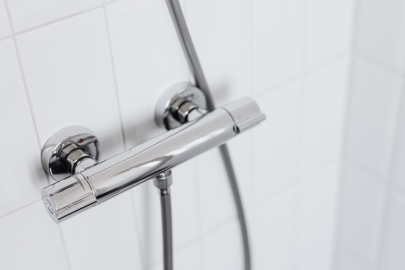
Shower valves look alike on a product page and behave very differently once they're in the wall. One has a single lever, another has three crossheads, a third is labelled "dual" but only feeds one shower head, and the minimum pressure listed might be 0.1 bar or 2 bar. Pick the wrong combination and the problem usually shows up after the tiles are on: the valve doesn't suit the pipework, the head and handset don't switch the way you expected, or the shower runs weakly on your water system.
The valve controls water flow and temperature, and the right one depends on your bathroom layout, your home's water system, and how you want the shower arranged. This guide covers the main types, what controls and outlets mean, the pressure figures worth checking, and what to look for when replacing an existing valve.
The valve is responsible for mixing and controlling the water. Hot and cold water enter through separate inlets, where a cartridge inside blends them to your chosen temperature and regulates the flow. The mixed water then exits through an outlet to whatever fixture is connected, such as a fixed shower head or a handset.
This makes the valve the control unit, rather than the shower itself. The head, hose, and slider rail are separate components supplied by the valve. If a valve has multiple outlets, a diverter determines which fitting receives the water (more on that below).
We've covered the mixing principle in our guide to how a mixer shower works, so this article stays with the buying decisions.
This is the first real decision, and it comes down to how much of the temperature control you want the valve to handle.
| Feature | Thermostatic valve | Manual valve |
|---|---|---|
| How the temperature is held | Adjusts the hot and cold mix automatically to keep the temperature you've selected, within its operating conditions | You set the mix by hand and adjust it yourself if the water runs hotter or colder |
| If a tap or appliance is used elsewhere | Helps reduce sudden changes in temperature | Doesn't compensate in the same way, so the temperature can shift |
| Maximum temperature stop and safety features | Many have a maximum temperature stop. Some models reduce or stop the flow if the cold supply fails, but features differ between models | Varies by model, so check the specification |
| Where it tends to suit | Family bathrooms and homes where other taps are often used during a shower | Installations where a simpler control is preferred and the valve suits the water system and how it will be used |
A thermostatic valve helps keep the temperature steady, but it doesn't replace correct installation, commissioning and servicing, and it doesn't remove every risk from hot water. The details differ by product too. For example, the Delphi Loop valve in our range is listed as TMV2 approved, with a specified temperature accuracy of within 2°C and automatic flow shut-off if the cold supply fails. Features and operating conditions vary between products, so check the individual specification and installation instructions.
Manual valves have their place. A manual valve doesn't hold a set temperature automatically, so the mix can change if water is drawn off elsewhere in the house. That's the trade-off: a simpler design, with the adjusting left to you.
These terms describe where the valve is installed. They say nothing about how the temperature is controlled or how many outlets the valve feeds, so a thermostatic valve can be concealed or exposed, and so can a manual one.
| Feature | Exposed valve | Concealed valve |
|---|---|---|
| Position | Mounted on the finished wall, with the valve body on show | Main body and pipework sit behind the finished wall, with only the plate and handles visible |
| Appearance | Available in traditional and modern styles, with more hardware on show | Cleaner and less cluttered |
| Access | Pipe connections are generally accessible, so inspection and servicing are often easier | Access for future maintenance is worth planning before the wall is finished |
| Wall work | Can suit a bathroom where big changes to the wall aren't wanted | Needs enough space in the wall and careful planning before tiling |
Depth is the practical limit with concealed valves. Each model lists the recess depth it needs (72mm to 85mm on one valve, for example), so check that the wall build-up leaves room for the body before ordering.
A bar valve is a common type of exposed valve. It has a bar-shaped body, mounted horizontally or vertically, that carries the controls and the hot and cold connections, and it's fixed to the wall surface like any other exposed valve. Retailers, ourselves included, often list bar valves under their own heading, but it's a format within the exposed range rather than a separate kind of valve.
If you're replacing an exposed or bar valve, look at the pipe connections, the overall dimensions, the centres between the two inlets and the manufacturer's fitting requirements. Inlet centres vary between valves of all types: one valve lists 150mm, while another has inlet centres of 99mm. A familiar arrangement on the old valve is no guarantee that a new one will line up.
An outlet is a connection on the valve that sends water to something. Depending on the valve and your set-up, that might be a fixed overhead head, a handset, separate body jets, or a bath spout where the valve is designed for one. The number of outlets is the number of those fittings the valve can supply.
The number of outlets doesn't tell you how many handles the valve has. That's a separate question, and the next section deals with it, along with what the words single, dual and triple really refer to.
Controls are the handles, levers, knobs or crossheads you operate. Our shower valves category splits them into one, two and three controls, and that's where the words single, dual and triple in a product title come from. The number of outlets is listed separately.
The arrangements you'll come across:
Controls and outlets are separate specifications. A two-control valve doesn't automatically have two outlets, and a two-outlet valve doesn't automatically have two handles. These arrangements show the difference:
| Arrangement | Controls | Outlets | One way it can work |
|---|---|---|---|
| One control, one outlet | 1 | 1 | A single lever: lift to start the water, turn to change the temperature |
| Two controls, one outlet | 2 | 1 | One handle for flow and one for temperature, feeding a single fixed head or kit |
| Two controls, two outlets | 2 | 2 | One handle sets the temperature, the other turns the water on and diverts it between the fixed head and handset |
| Three controls, two outlets | 3 | 2 | One handle sets the temperature, and each of the other two opens one outlet, alone or together |
The second and third rows both have two controls, and only one of them has two outlets. The third and fourth rows both feed two outlets, but one has two handles and the other has three.
Product names add to the confusion. On our site "dual" means two controls, but other retailers and manufacturers can use the word differently, so read the specification and the control layout rather than relying on the title. What each handle does can also differ from one manufacturer to the next.
A diverter selects which outlet receives the water. On a valve feeding a fixed head and a handset, it's the part that lets you switch between them, and on valves with more outlets it selects between those where the valve supports it.
Some valves have a separate diverter control. Others build the function into a handle that does something else as well. On some two-outlet valves with two controls, the same handle that turns the water on also diverts it, which is how the valve manages two outlets with two controls.
Switching between outlets and running them together are different things. A diverter sends the water to the outlet you've chosen. To run two outlets together, a valve generally needs a way of opening each one independently, as some three-control valves do, with an outer handle for each outlet. Even then, only the manufacturer can confirm which combinations are supported, so don't assume a multi-outlet valve will run all its outlets at once. If two do run together, they share the available flow, so each delivers less than it would on its own.
The number of controls is no reliable guide to the number of diverter positions either. What the specification says the valve can do is the only safe measure.
There isn't one figure for shower valves. Each is designed to work within a range of pressures, and the range depends on the product. Listed minimum pressures across our range run from as low as 0.1 bar to 2 bar, and even valves from the same range can differ from one another. Maximums vary too.
No single number, whether 0.5 bar, 1 bar or anything else, works as the standard, so the figure for the specific valve is the one that counts.
Data sheets often go further, giving a minimum dynamic pressure, a maximum dynamic pressure and a maximum static pressure. Dynamic means the pressure while water is flowing, and static is the pressure in the pipes when everything is off. One manufacturer's data sheet for a concealed thermostatic valve, for example, lists 0.1 bar minimum dynamic, 5 bar maximum dynamic and 10 bar maximum static. The maximum figures matter as much as the minimum, particularly on a higher-pressure supply.
Pressure and flow rate aren't the same thing. Pressure is the force pushing water through the pipework, measured in bar. Flow rate is the volume that comes out over time, measured in litres per minute. A valve's minimum pressure is the point at which it's designed to work, not a promise of how much water reaches the shower head. Data sheets usually give flow rates at several pressures, and the flow rises with the pressure but nowhere near in proportion. Fittings play a part too. For example, Bristan's 1901 exposed concentric valve is listed at 13.4 litres per minute at 1 bar with flow limiters fitted, compared with 20.7 litres per minute without them. The shower head, pipework and other restrictions also affect the flow reaching the outlet.
A valve doesn't create or boost pressure. It controls what arrives. If the supply is weak, a valve with a lower minimum pressure helps it work, but it won't make the supply stronger, and improving a weak supply is a separate job from choosing the valve.
Hot and cold supplies both count. Some manufacturers describe their valves as suitable for all plumbing systems but "ideally balanced", meaning hot and cold arriving at similar pressures. Others set different requirements, so there's no rule that applies to every valve. Unbalanced supplies can happen in ordinary homes, such as hot water from a loft-tank-fed cylinder with the cold coming straight from the mains.
The type of system sets the starting point:
Outside its stated conditions, a valve may not mix or flow as it was designed to. If you're not sure which type of system you have, our guide to understanding your water pressure system explains how to find out.
Work through these in order. Each one narrows the options before the next.
When you're ready to compare, our shower valves range can be filtered by temperature control, valve position, number of controls, number of outlets and low pressure suitability.
A new valve that looks like the old one isn't necessarily a like-for-like swap. The plate can match while the body behind it doesn't, and there's no guarantee that faceplates, cartridges or valve bodies will interchange between brands, or even between ranges from the same brand.
Before ordering, find out:
If the current valve is concealed, a replacement may mean getting behind the finished wall, and if the existing body can't be reused that could involve taking tiles off. Where the valve is faulty rather than out of date, a replacement cartridge may be enough, but that depends on the model and what has gone wrong.
Some of the work is within reach of a confident DIYer and some of it isn't, and the difference is mostly what's behind the wall.
Swapping an exposed valve for one that fits the existing connections is at the easier end, provided the pipework is sound and the new valve suits the supply. Concealed installations are another matter. Pipework alterations, openings in the wall and the waterproofing around them are where mistakes get expensive, and replacing a complete valve body is a bigger job than replacing a cartridge.
Thermostatic valves add one more step. Some manufacturers' instructions include checking, commissioning or calibrating the valve after fitting, and a thermostatic valve that hasn't been set up properly can't be relied on to do what it's meant to. A poorly made connection, a weak seal or a valve fitted to a supply it wasn't designed for can leave you with leaks behind the wall or a shower that never works as it should.
For significant pipework changes, a concealed installation or any doubt about what's already in the wall, use a qualified plumber.

Learn about shower tray waste types, sizes, traps and flow rates, with practical advice on choosing a compatible replacement.
Learn how cable and pneumatic toilet flush buttons work, how to identify your mechanism and what to check before buying a replacement.
Selecting a basin for a vanity unit requires careful consideration of physical compatibility and plumbing clearances, not just aesthetic appeal. Ensuring the dimensions, mounting style, tap placement, and waste configuration align will prevent installation issues.

By signing up I agree to receive HeatandPlumb.com emails and to the privacy policy. I can also unsubscribe at any time