
0
£0.00
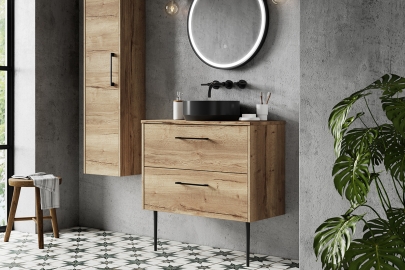
Choosing between floor-standing and wall-mounted vanity units should be straightforward, but it's actually one of those decisions where both options have genuine advantages and some proper drawbacks that aren't immediately obvious until you've lived with them.
Your bathroom layout, the state of your walls, and what you actually need from the unit all factor in significantly. Here's what actually matters when making this choice.
Floor-standing units sit directly on your bathroom floor like normal furniture, with feet or a plinth supporting their weight, and you can basically just position them where you want without worrying too much about wall strength. They're self-supporting and take their entire weight through the floor.
Wall-mounted units (also called wall-hung or floating units) are fixed directly to the wall with heavy-duty brackets, with no contact with the floor whatsoever. They hang there suspended, creating a visible gap underneath that changes how the bathroom feels and functions.
That gap underneath is where most of the practical differences and debates happen, affecting everything from cleaning to storage capacity to installation complexity.
Wall-mounted units make small bathrooms feel bigger through a clever optical illusion. The visible floor continuing underneath the unit creates visual breathing room that extends the perceived space, even though you're not actually gaining any usable floor area.
It's not genuine extra space that you can use for anything practical - you can't really store much under a wall-hung unit because you need access for cleaning and plumbing. But psychologically and visually, it makes the room feel less cluttered and more open, which matters considerably in compact bathrooms where every visual trick helps.
Floor-standing units have more physical presence and visual weight. They can make a small bathroom feel more cramped because they occupy floor space completely, though in a larger bathroom this substantial appearance can actually look more expensive and purposeful rather than being a drawback.
Here's something that matters more than most people realise when choosing: cleaning around floor-standing units is genuinely a pain in the backside.
You've got to navigate around the base with your mop, get into the corners where dust and hair accumulate, deal with that annoying gap between the unit and the wall where grime congregates, and if the unit's in an awkward spot you're basically giving up on properly cleaning behind it. Over time, that inaccessible area becomes progressively grimier.
Wall-mounted units solve this completely. Just run your mop straight underneath in one sweep, clean the entire floor in minutes, done. It's genuinely easier, especially if you've got a family and need to clean the bathroom regularly rather than just occasionally.
The unit itself collects less general bathroom grime too because it's not sitting in any puddles or water splashes that inevitably accumulate on bathroom floors around sinks and toilets.
Floor-standing units generally offer substantially more storage volume for the same overall footprint. The full height from floor to countertop means more drawer space or cupboard depth, giving you proper capacity for storing toiletries, cleaning products, and all the accumulated bathroom clutter.
Wall-mounted units lose that bottom section entirely - they typically start higher up to give you adequate floor clearance underneath, which looks good but means less internal storage. For the same external dimensions, you're getting noticeably less usable space inside.
If you've got loads of bathroom products and limited storage elsewhere in your home, a floor-standing unit might prove more practical despite the cleaning drawbacks. If you're reasonably minimalist or have alternative storage sorted, the reduced capacity of a wall-hung unit probably won't bother you day-to-day.
Floor-standing units are considerably easier to fit, which matters if you're DIYing or want to keep installation costs down. Position it roughly where it needs to go, level it up if the floor's not perfectly flat, connect the plumbing, seal it to the wall, done. Reasonably straightforward for anyone competent with basic DIY.
Wall-mounted units demand solid walls capable of supporting significant weight. Not plasterboard on timber frames - you need proper brick or blockwork that can handle the combined weight of the unit itself, the basin full of water, and you leaning heavily on it whilst brushing your teeth or doing your makeup.
You'll need a proper mounting frame or very secure fixings that go deep into solid wall material. Get this wrong and the entire unit comes off the wall months later, which is absolutely catastrophic and potentially dangerous. Installation usually takes longer and costs more if you're paying someone, but the end result looks considerably sleeker.
Wall-mounted units read as distinctly more modern and minimalist in character. They're what you see constantly in contemporary bathroom showrooms, design magazines, and hotel bathrooms that are trying to look current and upmarket.
Floor-standing units can look traditional or modern depending on their specific design and finish, but they have an inherently more conventional appearance. In a period property or traditional-style bathroom, they often fit the overall aesthetic better and don't feel visually jarring against Victorian tiles or classic fixtures.
Neither is inherently more stylish than the other - it genuinely depends on the overall bathroom aesthetic you're creating and what fits coherently with everything else you've chosen.
Floor-standing units hide pipework completely inside the cupboard space. Need to access your plumbing for repairs or modifications? Open the door, everything's right there, sorted. You can get to the waste pipe, water supply, and any valves without dismantling anything.
Wall-mounted units often have exposed or semi-exposed pipework running behind them to the wall connections. Some people box this pipework in with tiling or panels for a cleaner look, whilst others deliberately leave it on show with attractive chrome bottle traps and tidy pipework as a design feature.
If your plumbing's messy or you anticipate needing regular access for maintenance or adjustments, floor-standing makes life substantially simpler and less disruptive.
Generally speaking, floor-standing units are cheaper both to purchase and to install. They're simpler to manufacture, easier to transport without damage, and require less specialist installation knowledge or equipment.
Wall-mounted units cost more upfront for equivalent quality, and installation carries a higher price tag due to the mounting hardware required, longer installation time, and need for greater precision. You're paying extra for that modern floating aesthetic and the practical cleaning benefits.
The difference isn't astronomical for like-for-like quality - maybe 20-40% more for wall-hung once you factor in proper installation costs - but it's worth considering if you're working to a tight bathroom budget.
Floor-standing units are mechanically simpler and more stable. They sit there solidly, they don't move, and there's not much structurally that can go wrong over time. They just work without drama.
Wall-mounted units rely entirely on their wall fixings remaining solid and secure indefinitely. In a busy family bathroom with kids pulling themselves up on the basin, leaning heavily whilst cleaning teeth, or generally being less careful than adults, those wall fixings take constant stress over years.
Properly installed with adequate fixings into solid walls, they're absolutely fine for decades. But if there's any movement in the walls over time, inadequate fixings initially, or the wrong wall type, you can develop problems with loosening or even catastrophic failure.
Wall-mounted units offer genuine flexibility for accessibility needs because they can be fitted at custom heights tailored to specific requirements. Need it lower for wheelchair users or children? No problem, mount it wherever works best.
Floor-standing units come at fixed heights determined by their design and construction. There's no adjustment possible - you get whatever height the manufacturer built, which might not suit everyone's needs, particularly if you have specific accessibility requirements or physical limitations.
Honestly, both options work perfectly fine in appropriate situations. It's more about matching the right solution to your specific bathroom and circumstances rather than one being universally superior.
Small bathroom that feels cramped and claustrophobic? Wall-mounted might justify the extra cost and installation complexity through the visual space gains and easier cleaning.
Need maximum storage capacity and want simpler DIY installation? Floor-standing makes obvious sense and saves you money for equivalent quality.
Concerned about wall strength or working with plasterboard stud walls that can't support much weight? Definitely floor-standing, because wall-mounting isn't safely possible.
Want that contemporary floating aesthetic and prepared to invest in proper professional installation? Go wall-mounted and accept the higher costs. There genuinely isn't a universally "better" option here. Both types have been popular for decades because they both work well in their appropriate contexts.
Want more detailed advice on picking the right vanity configuration for your needs? Check out our vanity unit buying guide over on our blog.
At Heat and Plumb, we understand that choosing bathroom furniture involves balancing aesthetics, practicality, and budget - which is why we stock over 30,000 products covering every mounting style and price point you can imagine. Our range of furniture pieces designed to elevate bathroom interiors includes everything from traditional floor-standing units with generous storage through to sleek wall-mounted pieces for contemporary spaces.
Plus, free delivery to most of the UK takes the sting out of bathroom renovation costs, especially when you're buying heavy furniture pieces. And because we've spent 20 years building relationships with quality manufacturers, we can offer pricing that's genuinely competitive rather than just claiming to be.
What really distinguishes us is having staff who'll actually talk you through the technical stuff - like whether your walls can support a wall-mounted unit, or how to work around awkward plumbing.

Not safely on plasterboard alone - it won't reliably support the weight long-term and risks catastrophic failure. You need to either hit timber studs behind the plasterboard with long fixings, use a proper mounting frame that distributes weight across multiple studs, or ideally have solid brick or blockwork walls. If you've only got plasterboard stud walls, a floor-standing unit is the safer, more sensible choice.
Properly installed into solid walls with appropriate fixings, wall-mounted units can safely support 100-150kg or more, which includes the unit itself, basin, water, and someone leaning on it. The critical factor is installation quality and wall strength rather than the unit itself. Always follow manufacturer installation instructions exactly and use the specified fixing types for your wall construction.
Not necessarily, though the plumbing is more visible and needs to look tidy since it's not hidden inside a cupboard. You'll need wall-mounted taps or basin-mounted taps, and the waste pipe needs to come through the wall at the right height. Most plumbers can adapt existing pipework to suit, but it might cost slightly more than connecting a floor-standing unit where everything's hidden.
Wall-mounted units are currently more fashionable and appear in show homes and property listings as desirable modern features, which might marginally help with perceived value. However, quality matters far more than mounting style - a high-quality floor-standing unit beats a cheap wall-mounted one for adding value. Choose based on what works for your bathroom rather than resale speculation.
Technically yes, but it's not straightforward. You'd need to verify your walls can support the weight, install proper mounting brackets, potentially relocate plumbing connections, and probably retile or refinish the area where the floor-standing unit was. It's essentially a significant bathroom renovation rather than a simple swap. Better to choose the right option initially rather than planning to change later.
That's literally one of the main benefits - just mop straight underneath like the rest of your floor. The unit should be mounted high enough (typically 200-300mm clearance) to get a mop or vacuum underneath easily. Avoid mounting them too low to save space, as this defeats the cleaning advantage and makes accessing the area awkward.
Learn about shower tray waste types, sizes, traps and flow rates, with practical advice on choosing a compatible replacement.
Learn how cable and pneumatic toilet flush buttons work, how to identify your mechanism and what to check before buying a replacement.
Selecting a basin for a vanity unit requires careful consideration of physical compatibility and plumbing clearances, not just aesthetic appeal. Ensuring the dimensions, mounting style, tap placement, and waste configuration align will prevent installation issues.

By signing up I agree to receive HeatandPlumb.com emails and to the privacy policy. I can also unsubscribe at any time